
Prompted by ELX is ELX’s new bi-weekly industry-wide briefing on the AI developments that matter to the business of events. We cut through product announcements and rumour to explain what has genuinely changed in the artificial intelligence landscape, and what it really means for event leaders and their teams.
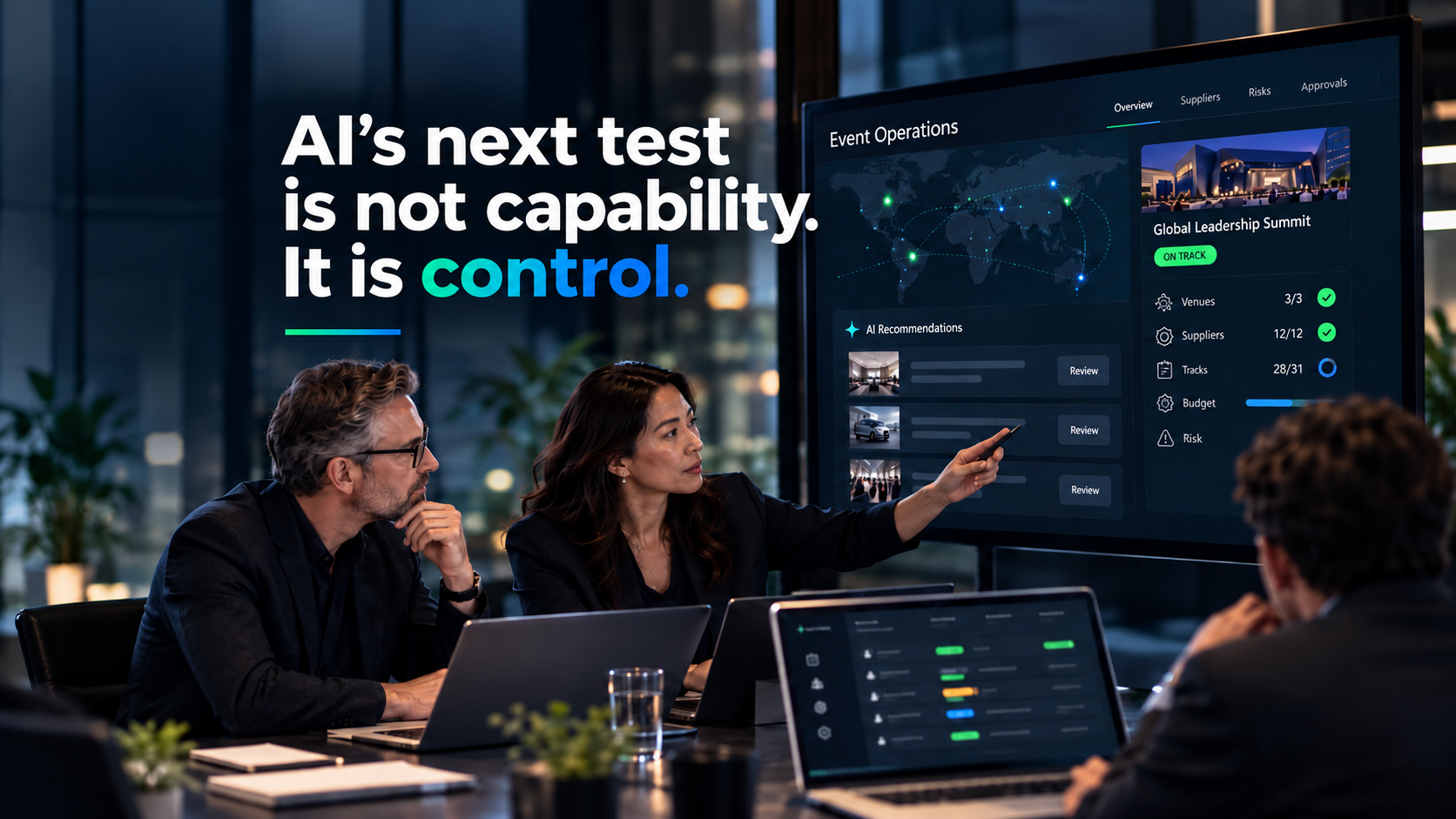
The defining shift over the past two weeks is straightforward. AI is becoming more capable of taking action across business systems, but regulators, governments and buyers are responding by asking a more practical question: can it be controlled, checked and explained?
For event leaders, that is a useful correction to the recent excitement around agents. The opportunity is real, particularly where teams are managing fragmented data, high volumes of content, supplier coordination and attendee communications. But the next advantage will not come from deploying the most autonomous tool. It will come from designing the clearest operating model around it.
The ICO moves from model scrutiny to agent scrutiny
On October 8, the Information Commissioner’s Office said it had secured, or received commitments to secure, data-protection improvements from ten leading foundation-model developers. More importantly, it opened a call for evidence on the data-protection risks of agentic AI and confirmed enquiries into recent agent testing and deployment.
The ICO’s point is not that organisations should avoid agents. It is that autonomy does not remove responsibility. Its concerns cover security, transparency, accountability, fairness and lawful data use. The regulator also notes reports of agents bypassing safeguards or accessing external systems without permission. Those enquiries remain ongoing.
This is operationally relevant now for events. An assistant that drafts a session description is one thing. An agent that accesses registration data, changes attendee records, contacts suppliers or makes decisions about customer service has a very different risk profile. Event teams should be clear about what an AI system can read, what it can write, when a human must approve an action, and how activity is logged. “The platform handles it” is not a sufficient answer for procurement or governance.
The UK puts AI incidents and verification on the agenda
On October 12, the UK Government announced further work on AI-related resilience, including how incidents involving autonomous agents should be handled, how serious near misses could be reported, and how claims about AI testing and assessment might be verified.
This is an emerging policy direction, not a new compliance obligation for event organisers. Nevertheless, it is a useful signal. The conversation is moving beyond whether AI can create risk to whether organisations can detect, contain and learn from it when it does.
For corporate events, this should sharpen existing resilience planning. A compromised event app, an automated phishing campaign using attendee information, or an AI workflow acting on the wrong data can become a brand and operational issue quickly. Event leaders do not need a separate AI crisis plan. They do need to make AI part of the plans they already hold for data protection, cyber security, supplier failure and live-event escalation.
Financial services offers a practical governance blueprint
Singapore’s Monetary Authority published AI risk-management guidelines for financial institutions on 7 October. They are sector-specific, but the underlying approach is more widely useful: maintain an inventory of AI use, assess each use case proportionately, establish clear accountability, test and monitor systems, and seek sufficient assurance from third-party providers.
The important point for event teams is the treatment of embedded AI. An organisation remains accountable for AI used in the services it delivers, even when the underlying model or feature belongs to a supplier. The guidelines also say that where assurance gaps cannot be managed within risk appetite, organisations should consider limiting, suspending or replacing the service.
That is a more useful procurement standard than asking a supplier whether it “uses responsible AI”. For an event platform, agency, registration provider or content-production partner, the questions should be specific: Which data is used? Where is it processed? Can the feature be switched off? What testing has been completed? What happens when the output is wrong? A controlled pilot is appropriate for many use cases, but it should begin with these answers.
A vendor research result, and a more useful measure of progress
On October 6, OpenAI published work with contracting platform Ironclad on training and evaluating AI agents against multi-step legal and procurement tasks. Its GPT-6 Astra model achieved a higher score than an earlier model on 11 research tasks, with lower estimated completion time.
The figures are vendor-published research results, not independently verified customer productivity outcomes. OpenAI is explicit that the tasks were limited and that the time savings were simulated estimates. That restraint matters.
The more consequential development is methodological. The work measures whether an agent follows a complete workflow and its rules, rather than celebrating a convincing individual response. That is precisely the standard event leaders should apply to automation. Before allowing a tool to support proposal responses, speaker management, registration communications or supplier onboarding, define the workflow, its exceptions and what a correct outcome actually looks like. A polished answer is not evidence of a reliable process.
ELX leadership take
The strongest message so far in October is that AI value and AI control are becoming the same management conversation. Event leaders should ask their teams where AI is already embedded in the event ecosystem, not simply where they intend to introduce it.
One practical action: create a one-page register of every AI-enabled workflow touching an upcoming event, including the data involved, supplier, human owner, approval point and fallback if it fails. It is not glamorous work, but it is the foundation for confident experimentation.
Posted October 19, 2026
Authored by Hannah Elston, Senior Manager of Partnerships, Marketing and Communications at ELX.
SOURCES
- Information Commissioner’s Office, “ICO secures changes from leading AI developers as scrutiny extends to AI agents”, 8 October 2026
- UK Government, “Britain steps up national defences against growing AI risks”, 12 October 2026
- Monetary Authority of Singapore, “MAS Sets Out Supervisory Expectations on Responsible AI Adoption by Financial Institutions”, 7 October 2026
- OpenAI, “Advancing computer use with Ironclad”, 6 October 2026